
Finance Minister Nirmala Sitharaman is scheduled to address the post-budget meeting of the RBI's central board on Monday and highlight key points of the Union Budget 2022-23, including the fiscal consolidation roadmap and high capex plan. It has been a custom that the finance minister addresses the RBI board, consisting of RBI Governor and existing four deputy governors, after the Budget. The meeting has been scheduled for February 14 where she would be addressing the board members and talk about announcements made in the Budget to perk up growth hit by three waves of COVID-19, sources said.
Tuesday's policy announcement had a regulatory and development component.

Realty sector is facing a huge slowdown for last 3-4 years, leading to a significant delays in possession of flats to customers.

India's economic growth is estimated to have slowed down to 11-year low of 5 per cent during the current financial year ending March 2020.

After two years of a record low interest-rate regime, Indian corporate houses are experiencing a sharp and abrupt increase in funding costs. With the Reserve Bank of India last month making an unequivocal turn towards policy tightening amid high inflation, firms looking to tap the capital markets for funds are ending up shelling out more. The yield on the benchmark triple-A-rated corporate bonds maturing in three years has climbed 98 basis points (bps) since the policy rate hike in May. It was last at 7.47 per cent, Bloomberg data showed.

With RBI likely to make credit costlier and banks to follow, some ideas on switching money to be able to do this.

The Reserve Bank of India (RBI) on Wednesday announced an extension of interim ways and means advances (WMAs) limit of Rs 51,560 crore to state governments till September, to help them tide over the financial stress posed by the second wave of COVID-19. WMAs are temporary advances given by the RBI to the states to tide over any mismatch in receipts and payments. There are two types of WMA - normal and special. While normal WMA are clean advances, special WMA are secured advances provided against the pledge of the government of India dated securities.

Most banks are yet to pass on the benefits to the consumers.

There is a near consensus that at least a 25 basis points cut, if not 50, can be expected in the June policy.

'The rising cost of construction, the cost of doing business, high compliance, and inflation/interest rates going up have already reduced returns to single digits.'

Many officials had been talking of taking the baton of global growth.

Rbi cut rates for teh third time to ease economic situation.
The industry also emphasised on supply-side interventions by the government to tackle persistently high food inflation.

RBI would get the comfort of meeting its 8 per cent January Consumer Price Index-based inflation target, BofA-ML said, adding that 'we expect the RBI to cut 75 bp in 2015 from February with inflation on course to 6 per cent in January 2016'.

Next bi-monthly policy statement on September 30.

If credit is not going to flow in response to a policy rate cut, while inflationary pressures, as well as expectations, may be stoked, a rate cut may not be appropriate at this point

Inflation fell to a three-decade low of 0.18 per cent, fuelling expectations that the Reserve Bank would signal cut in lending rates by banks as demanded by the industry which posted negative growth in February as well.

'If the majority falls short of expectations, it may prompt initial adjustments in investor sentiment.'
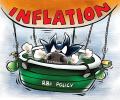
Reserve Bank on Wednesday said it expects retail inflation at 5.2 per cent in the first half of the current fiscal and revised downwards the target to 5 per cent for the quarter ended March. While headline inflation at 5 per cent in Feb 2021 remains within the tolerance band, some underline constituents are testing the upper tolerance level. Going forward, the food inflation trajectory will critically depend on the temporal and special progress of southwest monsoon in the 2021 season, RBI Governor Shaktikanta Das said on Wednesday while announcing the first monetary policy for the current fiscal. Reserve Bank of India (RBI) has kept the key repo rate unchanged at 4 per cent to support growth in the current situation.

The Reserve Bank of India (RBI) is expected to hold its policy interest rate at 6.75 per cent next week to stifle inflation.

The big test will come at the end of March when the fiscal year ends and banks tend to hold on to cash.

At its last policy review, the central bank left policy repo rates on hold at 7.25 percent, tying future cuts to inflation outlook.

Investors who decide to enter medium to long-duration funds should be cognisant of the risk.

The move will likely attract more retail investors.

Rajan announced a status-quo on interest rates.

Weighed down by a weak rupee, the Reserve Bank on Tuesday chose to keep all key interest rates unchanged and asked the government to take urgent steps to reign in the high current account deficit.

This was the near-unanimous replies of 10 market participants.

Equity benchmark Nifty scaled the psychological milestone of 21,000 in afternoon trade on Friday, and the Sensex touched its all-time intraday high of 69,888.33 after the central bank's decision to keep policy rates unchanged in line with market expectations. The 50-share benchmark index opened on a bullish note, after taking a breather on Thursday, and rose to 21,006.10. As many as 25 stocks were trading in the green, and 24 stocks defied the broader market and were trading in the negative territory.

The RBI may grant licences for setting up small finance and payment banks by April 2015.

After two surprising, successive rate cuts in January and February 2015, RBI governor Raghuram Rajan decided not to reduce them further in his first policy announcement in the new financial year. Is he playing spoilsport for consumers of homes and cars?
Banks in India are expected to cut lending rates by up to 50 basis points by September as there is sufficient liquidity in the system.
The Reserve Bank is unlikely to lower the interest rates.

The RBI has targeted 6 per cent inflation by January and 4 per cent by March 2018.

The RBI has made serious attempts to improve fiscal deficit.

Assocham expressed concern over the precarious situation that the manufacturing sector is in, observing that if the trend does not reverse with monetary and fiscal measures it would be difficult for the industry to generate jobs.

Axis Bank was the top laggard in the Sensex pack, plunging more than 5 per cent, followed by HDFC, Bajaj Finance, ICICI Bank, Tata Steel, Bajaj Auto, HDFC Bank and IndusInd Bank. On the other hand, M&M, Infosys, Asian Paints, UltraTech Cement and Tech Mahindra were among the gainers.

Finance Minister Nirmala Sitharaman has said the recent interest rate hike by the Reserve Bank was not surprising for her but the timing was, asserting that the rising cost of funds will not impact the government's planned infrastructure investments. For the first time since August 2018, RBI had on May 4 delivered a blunt 40 basis points increase in key repo rate to 4.40 per cent, and also hiked the cash reserve ratio by 50 basis points to 4.5 per cent after an unscheduled meeting of the rate setting panel, citing increased inflation pressures following the Ukraine war and the resultant spike in crude oil prices. Retail inflation printed at 6.9 per cent in March and the April reading is forecast to top 7.7 per cent.
.jpg)
According to the global financial services major, the primary concern for the RBI at the moment has to be anchoring elevated inflation expectations and stabilising the currency, which could face renewed pressures if the Fed begins QE tapering this week, as widely expected.

The RBI has this year cut interest rates by 110 basis points in four instalments but banks have passed only a part of it to borrowers. Before the last reduction earlier this month of 35 basis points, the bank on an average had passed only 29 basis points out of 75 basis points cut affected during 2019.

Banks have been reluctant to transmit the entire policy rate cut by RBI to borrowers.
